Invasive Species Distribution Modelling under Climate Change
Species distribution modelling for two invasive plants in India's Eastern Ghats under four climate-change scenarios, producing risk maps for land-use planning and early-warning decisions.
Overview
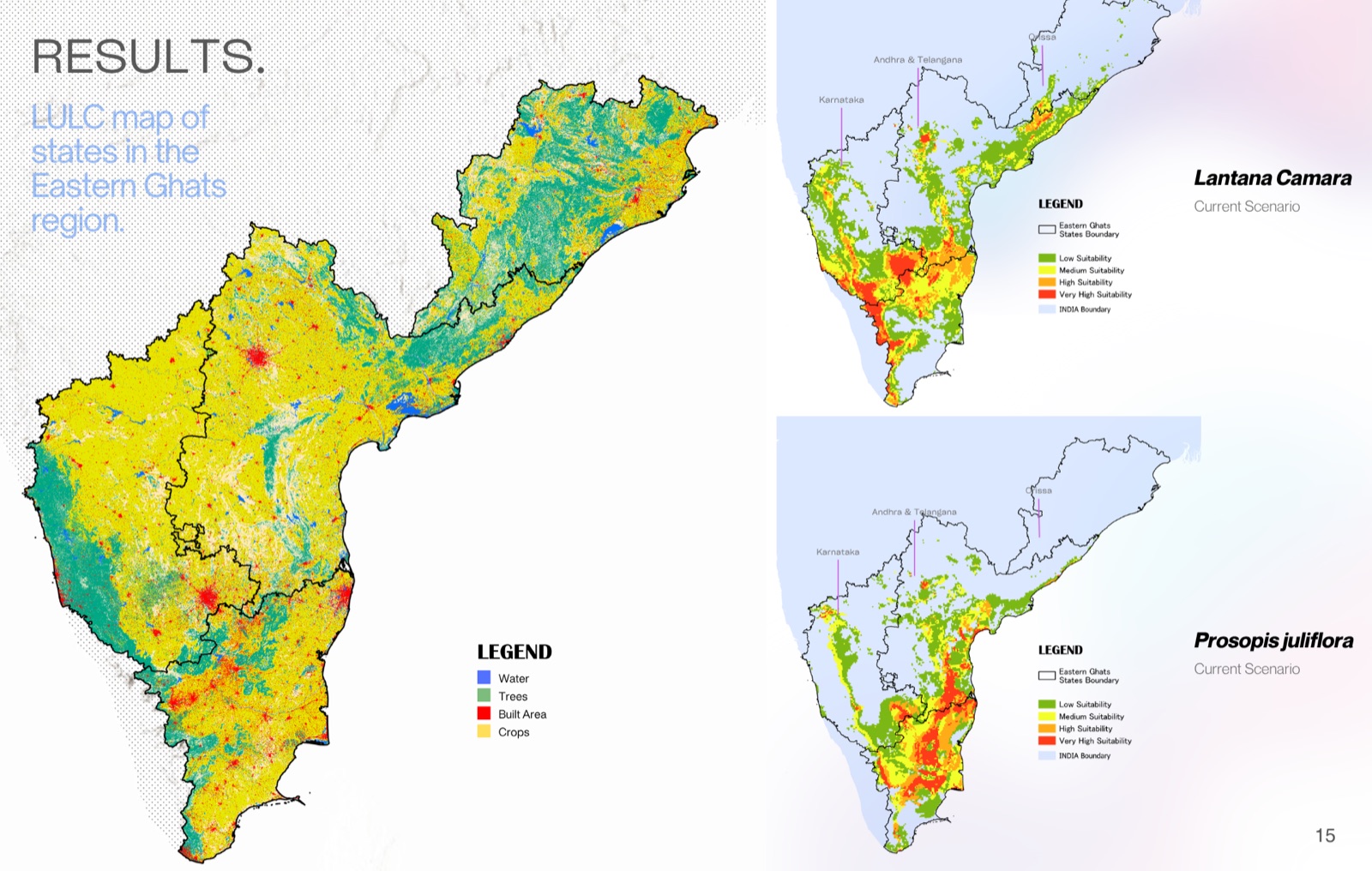
An MSc thesis modelling where two invasive plants, Prosopis juliflora and Lantana camara, are likely to spread across the Eastern Ghats region of India as the climate changes. Built at Wageningen University & Research, March to August 2024.
The problem
Both species are already established invaders in the region, and eradication is not realistic once a population takes hold. The useful question for a land manager is not "how do we remove it" but "where is it going next," and the answer depends on which climate future actually happens. A single projection hides that uncertainty, so the model needed to run under four different emissions scenarios and four future time windows rather than produce one number.
What I did
- Projected suitable habitat under four SSP climate scenarios (SSP1-2.6, SSP2-4.5, SSP3-7.0, SSP5-8.5) across four future periods, 2040s to 2090s, using CMIP6 climate data (BCC-CSM2-MR).
- Processed 19 bioclimatic variables from WorldClim 2.1: spatial extraction, layer stacking, a Pearson correlation pass to drop collinear variables, then conversion to ASCII in R and the SDM Toolbox.
- Built MaxEnt species distribution models, cross-validated and tuned for regularisation and feature classes via ENMeval, reaching AUC of 0.82 and 0.86.
- Applied spatial thinning (spThin) to correct sampling bias across 660+ occurrence records pulled from GBIF.
- Overlaid the habitat-suitability output on land-use/land-cover data in ArcGIS Pro to produce risk maps aimed at land-use planning and early-warning decisions.
- Documented the full pipeline, data to model to map, as a reproducible workflow rather than a one-off analysis.